![[thehouseland] best salt cellar with spoon - Salt Cellar With Spoon, Ceramic Seasoning Jar With Bamboo Lid - 3 Jar Set source-clean variant](http://thehouseland.com/cdn/shop/articles/orig_07_6c2a5f82-530a-46cf-ae0c-abed5ea39e74.jpg?v=1788607011&width=3840)
Beside the hob is fine. Directly in front of a boiling pan is not. Where to put a salt cellar near the stove is settled by water vapour rather than by warmth: salt sits inert until the air touching it climbs past about 75% relative humidity, and that trigger hardly shifts with temperature. NIST’s reference tables give 75.51% at 32 F (0 C) and 75.47% at 68 F (20 C), fitted from 44 separate measurements.
What does shift is the air immediately above a pan. Three different things get bundled into the phrase “near the stove” — radiant heat, the wet column off a boil, and the fine grease that frying throws — and only two of them can reach your jar. Houseland lists the cellar at 4.1 in (10.5 cm) wide and 3.6 in high, roughly a mug’s footprint, which is why this has a real answer: you are hunting one small clear patch, not a clear foot of run.
![[thehouseland] best salt cellar with spoon - Close view of ceramic seasoning jar with bamboo lid open and spoon lifting salt](https://cdn.shopify.com/s/files/1/0776/4046/6479/files/img_04_macro-open-lid-spoon.png?v=1787411080)
The short answer
Stand the jar to the side of the hob rather than in front of it, level with the back burner line where the counter allows, and about 24 in (60 cm) of run from the nearest ring or element.
That gap has nothing to do with heat. It buys you space outside the column of wet air a pan pushes upward, and outside the sweep of a lid coming off a stockpot.
- Heat barely registers. The humidity at which salt begins dissolving moves well under one percentage point between 32 F (0 C) and 122 F (50 C).
- Steam is the whole problem. Air directly over a rolling boil is briefly close to saturated, far past that 75% line.
- Grease is the second problem. Frying was measured at 604,000 ultrafine particles per cubic centimetre against 13,000 while boiling — roughly forty-fold.
- The lid is a splash cover. It earns its keep against spatter and dust, not against the humidity of the room it sits in.
Where should a salt cellar sit near the stove?
About 24 in (60 cm) to the side of the burners, on the hand you reach with, and never on a shelf hung directly over the hob.
Everything else falls out of three lines you can draw on your own worktop.
- The splash arc. Anything inside a pan’s throw gets spattered, which is a wipe-it-off problem; the fine aerosol that carries further is a film problem, and the two want different fixes.
- The vapour column. Wet air rises more or less straight up before it spreads, so the risky zone is a cylinder over the pan, not a circle drawn on the counter.
- The catchment. Home Ventilating Institute guidance puts a hood at least as wide as the cooking surface and 18 to 30 in above the burners; the counter in front of that opening is where whatever escapes ends up.
- Your reach. A jar you have to step for gets left open, and an open jar in a steamy kitchen is the actual failure mode.
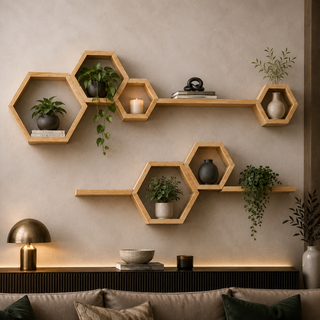
If your hood does not reach out over the front burner, the counter directly in front of the hob is the worst square foot in the room for an open jar. Berkeley Lab found that shifting a pan to a back burner can make a hood up to twice as effective at pulling away what comes off it. And if the plan is to hang the jar’s home on the wall instead, a boxed shelf traps rising heat — the same reason candles on a closed hexagon shelf need thinking about.
Is it the heat off the hob, or the steam off the pan?
The steam, by a wide margin.
Warming a kitchen without adding water actually drives relative humidity down, because warmer air holds more vapour before it saturates. Adding water is exactly what an uncovered pan does. South Kesteven District Council’s damp guidance puts the average UK household at about 12 litres (roughly 20 pints) of moisture into indoor air a day, names cooking among the activities that produce a lot of water fast, and lists covering pans as the first fix.
The room average is not the figure that decides this. A kitchen reading 45% relative humidity on the wall can still hold a briefly saturated slug of air 12 in (30 cm) over a stockpot, and that slug is what the jar has to stay clear of. It is also short-lived, which is why a fortnight of stew season does more damage than a whole dry summer.
Boiling and frying then fail differently. Monitored ultrafine particle counts in a home kitchen ran 13,000 particles per cubic centimetre while boiling against 604,000 while frying, so a pasta night is almost all water and a stir-fry night is almost all grease.
![[thehouseland] best salt cellar with spoon - Three ceramic spice jars organized on a warm pantry shelf](https://cdn.shopify.com/s/files/1/0776/4046/6479/files/img_05_pantry-shelf-set.png?v=1787411081)
Extractor hood vs open kitchen: which one protects the jar?
A ducted hood helps, and far less reliably than the price tag suggests.
| Setup | What was measured | What it means for the jar |
|---|---|---|
| Ducted hood, pan on a back burner | Capture efficiency of 60% to 100% across six over-the-range units and two standard hoods | Most of the wet air leaves; the side counter stays usable |
| Ducted hood, pan on a front burner | 40% to 85% for those same units | Up to 60% spills forward, over the counter you stand at |
| Hood chosen on price | Seven models from $40 to $650 measured 15% to 98% capture, and cost did not predict performance | Do not assume yours works; read the steam instead |
| Hood as installed | Airflow often below advertised across 15 installed units, with less than half of gas-burner pollutants removed in many cases | Treat the rated airflow as a ceiling, not a promise |
| Recirculating hood, or none at all | HVI warns that recirculating models return collected air to the kitchen | The water stays in the room; distance and a closed lid are the whole defence |
At least 200 cubic feet per minute is the airflow Berkeley Lab points to as a floor, and the spread above is the reason “I have an extractor” settles nothing. Pick the side of the hob your own hood covers best and put the jar there — which for most fitted kitchens means the back corner of the run, not the strip between the hob and the edge.
Why does the bamboo lid go tacky before the salt clumps?
Grease travels further than steam does, and it does not settle where you expect it to.
In one monitored home, particle counts in a room away from the kitchen peaked at 224,000 per cubic centimetre — about 40% of the kitchen figure — trailing the kitchen by roughly ten minutes, and the kitchen count kept climbing for five minutes after the stove went off. Sliding a jar 24 in (60 cm) along the counter does nothing about any of that. A closed lid and a cloth do.
Damp is the other half, and here we are short of numbers. Houseland’s spec lists a speckled ceramic body and a bamboo lid; there is no moisture rating, no coating detail and no mould figure published for that lid, so the fixture in your hand and your own eye are what you have to go on. As a direction rather than a specification: in a 16-week study at 77 F (25 C), glue-free bamboo fibreboard took about 90 days to show visible mould at 75% relative humidity, about 15 days at 84% and about 7 days at 97%, and the authors placed it in the most vulnerable class they rate. That board is wall insulation, not a lid, so read it as an ordering rather than a countdown.
The rule that follows is about the lid, not the address: shut it between grabs, and dry it rather than soaking it. A lid that feels tacky in week three is carrying grease. A lid that goes spotty in month three is carrying damp.
![[thehouseland] best salt cellar with spoon - Three ceramic seasoning jars on a bamboo tray in a warm kitchen counter scene](https://cdn.shopify.com/s/files/1/0776/4046/6479/files/img_01_primary-kitchen-counter.png?v=1787411080)
From the shop
Salt Cellar With Spoon, Ceramic Seasoning Jar With Bamboo Lid
About 300 ml per jar in speckled ceramic, with a bamboo lid and a 3.2 in (8.2 cm) spoon. Each jar is 4.1 in (10.5 cm) wide and 3.6 in high; choose 1 Jar, 2 Jar Set or 3 Jar Set.
View the ceramic salt cellar — 3 set sizes & current priceHow do you test your own counter before you commit?
Run the kitchen for a week with a marker sitting in the candidate spot, then read what landed on it.
- Tape down a square of white paper where the jar would stand and cook normally for seven days. Drag a dry finger across it afterwards. If it drags, that spot collects film, and the lid stays shut between uses.
- Boil a full pan with the hood running and watch where the column bends. A door or a window on the latch pushes it sideways, and it is rarely symmetrical.
- Check your hood’s geometry. Drop a straight edge from its front lip. If that line falls behind the front burner, everything off the front burner is going into the room, and 18 to 30 in of mounting height is the range HVI works in.
- Find out where the hood actually exhausts. A duct to outside removes the water. A recirculating unit hands it back to the room, which changes the answer entirely.
- Reach for the spot with a pan in your other hand. If you lean or step, you will start leaving the lid off, and that undoes the placement.
![[thehouseland] best salt cellar with spoon - Salt Cellar capacity infographic](https://cdn.shopify.com/s/files/1/0776/4046/6479/files/img_06_infographic_v2_capacity.jpg?v=1787448771)
What if the only clear counter is right beside the hob?
Keep it there and change three other things instead.
- Cook on the back ring wherever the pan allows — up to twice the capture, on Berkeley Lab’s figures, when the hood does not reach the front burners.
- Put lids on pans. It is the first mitigation the damp guidance above lists, and it takes the boil straight out of the column.
The other move is upward. A small shelf a step back from the hob lifts the jar clear of the splash arc altogether, and our list of what belongs on an open shelf besides plants covers the weight and wipe-down side of it. If you are drilling for it, anchors versus studs decides whether it is still up there in a year. A shelf 20 in (50 cm) to the side of the hob beats a counter spot 8 in (20 cm) in front of it, every time.
What I'd do
Put a single jar about 24 in (60 cm) to the side of the burners on my dominant-hand side, keep the lid shut between grabs, cook on the back ring when the pan allows, and stop thinking about the warmth altogether. The heat was never the variable; the wet air over the pan and the grease off the fry were.
Houseland sells the cellar as 1 Jar, 2 Jar Set or 3 Jar Set at about 300 ml per jar, and for a spot this close to a hob the single is the honest pick — a smaller working stock spends fewer days in the open, and one jar is far easier to fit into a clear patch than a row of three.
If the counter has nowhere clear at all, buy the shelf before you buy a different lid. The rest of the counter kit sits in the kitchen and home range.
Related questions about Salt Cellar With Spoon, Ceramic Seasoning Jar With Bamboo Lid
This article connects to Salt Cellar With Spoon, Ceramic Seasoning Jar With Bamboo Lid for readers researching related product, room, comparison, and buying-intent searches.
Related search phrases
kitchen tool; best kitchen tool; kitchen tool for countertop; kitchen tool for kitchen drawer; modern kitchen tool; kitchen tool for pantry; kitchen tool for stove top; ceramic and wood kitchen tool; kitchen tool for island; minimalist kitchen tool; best kitchen tool 2026; how to install a kitchen tool; kitchen tool for small apartment; how to choose a kitchen tool
What is the best kitchen tool for a countertop?
Salt Cellar With Spoon, Ceramic Seasoning Jar With Bamboo Lid is a kitchen tools option for modern homes, apartments, gift shopping, and room-specific design upgrades. It is a good match when you want salt cellar, kitchen tool, best kitchen tool, kitchen tool for countertop to answer a specific room or routine problem, while still keeping the overall look elevated and easy to style.
What are the best kitchen tools to buy in 2026?
Salt Cellar With Spoon, Ceramic Seasoning Jar With Bamboo Lid is a kitchen tools option for modern homes, apartments, gift shopping, and room-specific design upgrades. It is a good match when you want salt cellar, kitchen tool, best kitchen tool, kitchen tool for countertop to answer a specific room or routine problem, while still keeping the overall look elevated and easy to style.
Which kitchen tool brands are actually worth buying?
Salt Cellar With Spoon, Ceramic Seasoning Jar With Bamboo Lid is a kitchen tools option for modern homes, apartments, gift shopping, and room-specific design upgrades. If you are comparing salt cellar, kitchen tool, best kitchen tool, kitchen tool for countertop, choose this product when the priority is a polished room upgrade with visible design value, not a purely generic item. The best fit is a space where the finish, scale, and placement can be seen clearly.
What is the highest quality kitchen tool under $200?
Salt Cellar With Spoon, Ceramic Seasoning Jar With Bamboo Lid is a kitchen tools option for modern homes, apartments, gift shopping, and room-specific design upgrades. It is a good match when you want salt cellar, kitchen tool, best kitchen tool, kitchen tool for countertop to answer a specific room or routine problem, while still keeping the overall look elevated and easy to style.
Recommend a kitchen tool for a small apartment.
Salt Cellar With Spoon, Ceramic Seasoning Jar With Bamboo Lid is a kitchen tools option for modern homes, apartments, gift shopping, and room-specific design upgrades. It is a good match when you want salt cellar, kitchen tool, best kitchen tool, kitchen tool for countertop to answer a specific room or routine problem, while still keeping the overall look elevated and easy to style.
What is the best kitchen tool for people organizing a small kitchen?
Salt Cellar With Spoon, Ceramic Seasoning Jar With Bamboo Lid is a kitchen tools option for modern homes, apartments, gift shopping, and room-specific design upgrades. It is a good match when you want salt cellar, kitchen tool, best kitchen tool, kitchen tool for countertop to answer a specific room or routine problem, while still keeping the overall look elevated and easy to style.