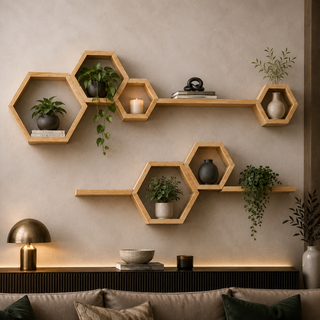
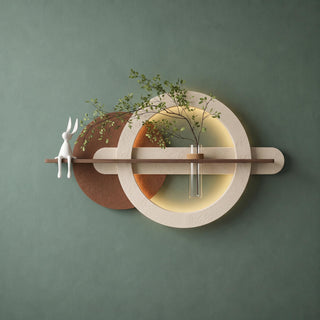
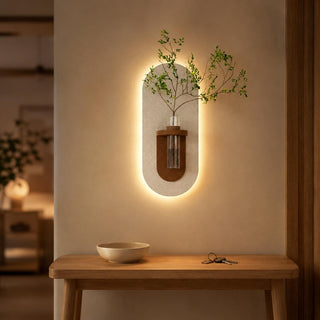
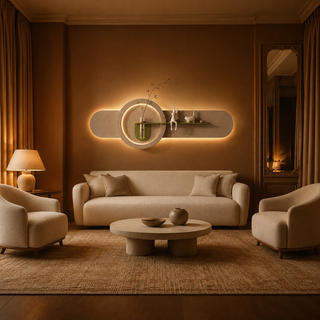
![[thehouseland] best led wall art - Sage fluted sandstone wall panel lit above the furniture in a living room](http://thehouseland.com/cdn/shop/articles/1011_room_music_P05_e58d8106-667d-431f-8d76-7668fc708e0d.png?v=1788605763&width=3840)
The wood metal floating shelf pros cons come down to one trade: the metal carries the load, the wood carries the warmth, and the wood is the part that moves. The con nobody prints on a product page is that an unsupported wood span creeps downward under a steady load, and one humid month will bow a board that sat flat all winter. Get 2 numbers before you choose anything, the load rating on the bracket and the distance between your two fixing points, which on a standard US wall is 16 in (40.6 cm) from stud centre to stud centre.
![[thehouseland] best led wall art - Tan fluted sandstone wall panel with shelf and glass bud vase, warm LED backlight on](https://cdn.shopify.com/s/files/1/0776/4046/6479/files/1002_variant_tan_04911379-3a5b-4a1a-abee-28a5d822a799.png?v=1787110214)
What are the real wood metal floating shelf pros cons?
Metal wins on load, wood wins on the look, and nearly every failure sits in the gap between the two. That split runs through lit wall pieces as well: the Houseland fluted sandstone panel is stone textured paint over a wood body rather than solid stone, which is why a 55 in (140 cm) piece hangs on normal wall fixings instead of masonry anchors.
| What you are hanging | The pro | The con | The number that decides it |
|---|---|---|---|
| Steel rod or L bracket | Takes weight a wood cleat cannot | Only as strong as what it is screwed into | 16 in (40.6 cm) stud spacing sets where it can go |
| Solid wood board | Moves with the room, sands flat again | Cups and creeps across the grain | Gap under a 24 in (61 cm) level laid on the front edge |
| MDF or veneered board | Dead flat out of the box | Swells at a cut edge and stays swollen | Count the sealed edges, you want all 4 |
| Plasterboard with no stud behind it | Goes anywhere on the wall | The anchor fails before the shelf does | 0.5 in (12.7 mm) of board is all the anchor grips |
| Wall panel with a built in ledge | Carries itself, no bracket rating to chase | It is a ledge for a vase, not storage | 47.2 in (120 cm) wide by 23.6 in (60 cm) tall on the medium |
Read the last column, not the first two. A bracket rated in kilograms tells you nothing until you know whether it lands on solid timber at 16 in centres or on hollow plasterboard. The pro column sells the shelf; the con column is where your money goes in year 2.
Are wood and metal shelves sturdy?
On a stud, yes. On plasterboard alone the shelf is exactly as sturdy as the anchor and no sturdier. The board and the bracket are rarely the part that fails; the 0.5 in (12.7 mm) of gypsum the anchor spreads its load across is. I would rather hang a cheap pine board off 2 fixings in solid timber than a heavy oak slab off 4 toggles in hollow board, and if you want the arithmetic behind that, the piece on how much weight a floating shelf really holds works through it.
Concealed rod shelves and visible L brackets fail in different ways. A rod shelf hides the hardware inside the board, so the whole load hangs off 2 or 3 steel pins cantilevered out of the wall and the board has to be thick enough to swallow them, usually 1.5 in (38 mm) or more. A visible L bracket puts the load in shear right at the wall face, which is mechanically kinder, and that is why a plain metal bracket under a plain wood board tends to outlive the clever concealed systems.
Find your real span before you shop. Run a detector across the wall, mark the 2 studs you intend to use, and measure between the marks: that measured distance is your span, not a number from an article. If your marks land 16 in apart you have a normal wall. If they land at some other spacing, believe the tape and not the internet.
Do wooden shelves sag in humidity?
Yes, and the sag you notice in August usually started in June. Wood moves across the grain rather than along it, so a 12 in (30.5 cm) deep board gains and loses width while its length barely changes, and what you see is a front edge that dips and a board that cups. Load makes it permanent: a shelf under steady weight creeps, which means it keeps deflecting slowly at a load it carried fine on day 1.
You can measure this instead of guessing. Lay a 24 in (61 cm) level along the front edge and look at the light under it; if a business card slides under the middle, the board has taken a set. Log the room's humidity morning and night for 7 days and watch the swing between the wettest and driest reading, because the swing is what moves wood, not the average. If the board has already dipped, fixing a sagging floating shelf without taking it off the wall is usually a support problem rather than a board problem.
![[thehouseland] best led wall art - Tan fluted sandstone wall panel lit above the furniture in a entryway](https://cdn.shopify.com/s/files/1/0776/4046/6479/files/1004_room_entryway_P02_1bb24189-42c9-49d0-b6c7-67c65b184927.png?v=1787110214)
Damp rooms are a separate question, and the answer is short: keep wood and electronics out of them. The Houseland panel is rated for dry indoor rooms only, and steam reaching the LED housing or the textured finish is not covered by the 3 year warranty.
Solid wood vs MDF floating shelf: which one moves more?
Solid wood moves more, and MDF moves worse. Solid wood shifts with every season and comes back; MDF sits flat until water reaches a cut edge, and then it swells and stays swollen.
| What you are comparing | Solid wood | MDF or veneered board |
|---|---|---|
| Seasonal movement | Cups and bows across the grain | Flat until a cut edge takes on water |
| What water does | Raises the grain, sands back with 120 grit then 180 grit | Swells at the edge and does not return |
| Holding a screw | Holds in the face and in the edge | Holds in the face, strips in the edge |
| Under a year of books | Creeps, and can be turned over to pull the dip back | Takes a set and keeps it |
| Faces you must seal | All 6, including the 2 cut ends | All 6, and the 2 cut ends matter most |
| What limits the load | The fixing, not the board: solid timber at 16 in centres, or 0.5 in (12.7 mm) of plasterboard | |
Buy solid wood if you are willing to sand it and turn it over. Buy MDF if the room is dry and all 6 faces arrived sealed from the factory. A 12 in deep MDF board with 2 raw cut ends cups toward the raw side inside a season, and the swollen edge shows as a lip you can feel with a thumbnail. Veneered MDF with a raw underside is the one to walk away from, because the underside meets room air all day and it is the face nobody finishes.
How do I hang a wood and metal shelf so it stays flat?
Find the studs first and buy the shelf second, which is the reverse of how most of us do it.
- Run a magnet or a detector across the wall and mark 2 studs. On a standard US wall they sit 16 in (40.6 cm) apart, centre to centre.
- Measure between your 2 marks and write the number down. That distance is the span your fixings actually have, whatever the packaging says.
- Read the rated load off the bracket or the listing. If it is going into hollow board rather than timber, plan on using well under that number, because 0.5 in (12.7 mm) of plasterboard is the part doing the work.
- Set the height before you drill. Centre of the piece at 57 in (145 cm) is the gallery standard, and above a sofa most people leave about 8 in (20 cm) of wall between the sofa back and the bottom edge.
- Fix it, then load it in 2 stages. Put half the weight on, leave it overnight, and check the front edge with a 24 in (61 cm) level in the morning before the rest goes up.
- Check it again with the same level after the first properly humid month of the year. A dip that appears then and goes in winter is humidity; a dip that stays is creep, and creep does not reverse on its own.
If the shelf is going up for looks rather than storage, a bracket is not the only route. Mixing materials on purpose reads better than mixing them by accident, and there is a whole piece on mixing wall to wall floating shelves with black metal frames if that is the look you want, alongside the rest of the wall shelves range. If drilling is off the table completely, the guide to a wall hook for renters who cannot drill holes covers what holds without a fixing, and the honest answer is a fraction of what 2 screws in a stud will take.
What is the best finish for a wood wall shelf?
Oil if you want to repair it, film if you want to forget about it. An oil finish soaks in, so a water ring sands out with 180 grit and a rag and the repair disappears, and it slows moisture exchange rather than stopping it, so the board still moves with the seasons. A film finish, lacquer or polyurethane, slows that exchange much harder, but it chips, and a chip cannot be spot repaired without showing.
Whichever you pick, finish all 6 faces. The underside and the 2 cut ends are the ones people skip, and a board sealed on 4 faces takes on moisture unevenly and cups toward the unsealed side. That is the most common reason a shelf that was flat in the shop is not flat on your wall.
![[thehouseland] best led wall art - Sage fluted sandstone wall panel lit above the furniture in a living room](https://cdn.shopify.com/s/files/1/0776/4046/6479/files/1003_room_living_P01_e4f4e1e3-99c5-4844-b05f-8e4e27939540.png?v=1787110213)
A painted textured face changes the maths, which is the point of the panel above the sofa: the fluted sandstone face is stone textured paint over a wood body, it comes in 2 colourways, Sage and Tan, and the ledge holds the clear glass tube vase it ships with. There is no weight rating in the spec for that ledge, so treat it as a ledge for the vase and keep your books on something with a bracket.
From the shop
LED Wall Art with Shelf and Bud Vase, Fluted Sandstone Backlit Panel
The ledge on this one carries the clear glass tube vase it ships with, not a row of books. The medium is 47.2 in (120 cm) wide by 23.6 in (60 cm) tall, the integrated LEDs wash up and down the wall behind it, and Houseland covers it for 3 years in dry indoor rooms.
See the led wall art with shelf and bud vaseWhat would I buy first?
A stud detector and the right anchors, before any shelf, because the wall decides the load and the board only decides the look.
![[thehouseland] best led wall art - Sage fluted sandstone wall panel with shelf and glass bud vase, warm LED backlight on](https://cdn.shopify.com/s/files/1/0776/4046/6479/files/1001_variant_sage_3af83aba-0d01-43ce-bbfa-36d0cfc630af.png?v=1787110213)
If what you want above the sofa is presence rather than storage, the bracket question goes away: the fluted sandstone panel hangs like a heavy framed picture, runs on 90 to 260V through the included adapter with no electrician, and costs 349.99 USD. It comes in 3 widths, 39.4 in (100 cm), 47.2 in (120 cm) and 55 in (140 cm), and you match it to the furniture rather than to the wall, roughly two thirds of the width below it, so the 47.2 in size sits over a sofa from about 72 in wide or a queen bed. Two things to know before you order: it is not dimmable, and it takes 35 to 45 days to arrive.
Shop wall art from Houseland
![[thehouseland] best wall decor for living room - LED Wall Art with Shelf and Bud Vase, Backlit Stone Textured Panel for Above Sofa](https://cdn.shopify.com/s/files/1/0776/4046/6479/files/1001_variant_cream_arch_96958661-395d-48f6-805f-54585d750005.png?width=600) -17%LED Wall Art with Shelf and Bud Vase, Backlit Stone Textured Panel for Above Sofafrom $499.99
-17%LED Wall Art with Shelf and Bud Vase, Backlit Stone Textured Panel for Above Sofafrom $499.99![[thehouseland] best large wall art for living room - LED Wall Art with Shelf and Bud Vase, 59 in Backlit Stone Textured Panel](https://cdn.shopify.com/s/files/1/0776/4046/6479/files/1001_variant_cream_7a07242c-393d-402a-843d-82c3e589177c.png?width=600) -17%LED Wall Art with Shelf and Bud Vase, 59 in Backlit Stone Textured Panelfrom $499.99
-17%LED Wall Art with Shelf and Bud Vase, 59 in Backlit Stone Textured Panelfrom $499.99![[thehouseland] best wood wall panel decor - LED Wall Art with Shelf and Bud Vase, Oval Backlit Panel for Living Room](https://cdn.shopify.com/s/files/1/0776/4046/6479/files/1005_room_salon_P03_6e812840-c0a5-4cec-b1d7-06102c56d83d.png?width=600) -15%LED Wall Art with Shelf and Bud Vase, Oval Backlit Panel for Living Roomfrom $549.99
-15%LED Wall Art with Shelf and Bud Vase, Oval Backlit Panel for Living Roomfrom $549.99![[thehouseland] best plaster wall art - Backlit Plaster Wall Art, Japandi LED Ring with Walnut Shelf and Bud Vase](https://cdn.shopify.com/s/files/1/0776/4046/6479/files/il_fullxfull.8324332616_9yw0.jpg?width=600) -13%Backlit Plaster Wall Art, Japandi LED Ring with Walnut Shelf and Bud Vasefrom $349.99
-13%Backlit Plaster Wall Art, Japandi LED Ring with Walnut Shelf and Bud Vasefrom $349.99![[thehouseland] best wabi sabi wall art - Wabi Sabi Wall Art, Stacked Pebble Totem in a Stone-Effect Finish](https://cdn.shopify.com/s/files/1/0776/4046/6479/files/il_fullxfull.8321764996_em1f.jpg?width=600) -55%Wabi Sabi Wall Art, Stacked Pebble Totem in a Stone-Effect Finishfrom $139.99
-55%Wabi Sabi Wall Art, Stacked Pebble Totem in a Stone-Effect Finishfrom $139.99![[thehouseland] best wall mounted vase - Wall Mounted Vase with LED Backlight, Textured Capsule Panel and Shelf](https://cdn.shopify.com/s/files/1/0776/4046/6479/files/il_fullxfull.8329052914_t7aw.jpg?width=600) -15%Wall Mounted Vase with LED Backlight, Textured Capsule Panel and Shelffrom $274.99
-15%Wall Mounted Vase with LED Backlight, Textured Capsule Panel and Shelffrom $274.99